



During the summer, work is being finalized on two specialized classrooms at the Faculty of Electrical Engineering and Information Technology of the Slovak University of Technology in Bratislava. From September, they will become the home of FEI RANGE – a wargame simulator designed for live incident response training. The simulator is an academic version of our BinConf RANGE platform and will allow students to experience realistic cyberattacks before entering professional practice.
Nowadays, when companies are looking for someone in cybersecurity, they usually aim for a person who can review a suspicious alert, read logs, understand attacker behavior, make decisions under pressure, and take the steps needed to stop a real incident.
This is one of the biggest challenges in today’s cybersec labor market. Regulations are increasing, pressure on companies is growing, and artificial intelligence has pushed the volume, speed, and sophistication of attacks to an unprecedented level. At the same time, there is a global shortage of millions of cybersecurity professionals, and in Slovakia alone, estimates from several years ago by National Security Authority estimated about tens of thousands of unfilled positions in this field.
The pressure on universities is growing as well, but schools face a difficult challenge: preparing graduates who are truly “job-ready.” A future security analyst needs an environment where they can safely make mistakes, experiment, analyze, compare procedures, and experience a level of stress similar to what comes with a real attack. FEI RANGE will give students exactly that opportunity: to experience cybersecurity in practice and move academic education to a completely new level.
The Labor Market Wants “Job-Ready” People. STU Can Help Deliver Them
FEI STU is one of the schools that has long been active in the field of information systems security. Traditionally, the faculty has had a strong background in areas such as cryptography and technical security. According to Štefan Balogh from the Institute of Mathematics and Computer Science at FEI STU, the labor market has increasingly been calling for experienced graduates who not only understand theory but also have practical exposure. “This type of knowledge is extremely valuable today. There are few people on the market who could join security centers straight after school and realistically work on incidents and solve them in practice.”
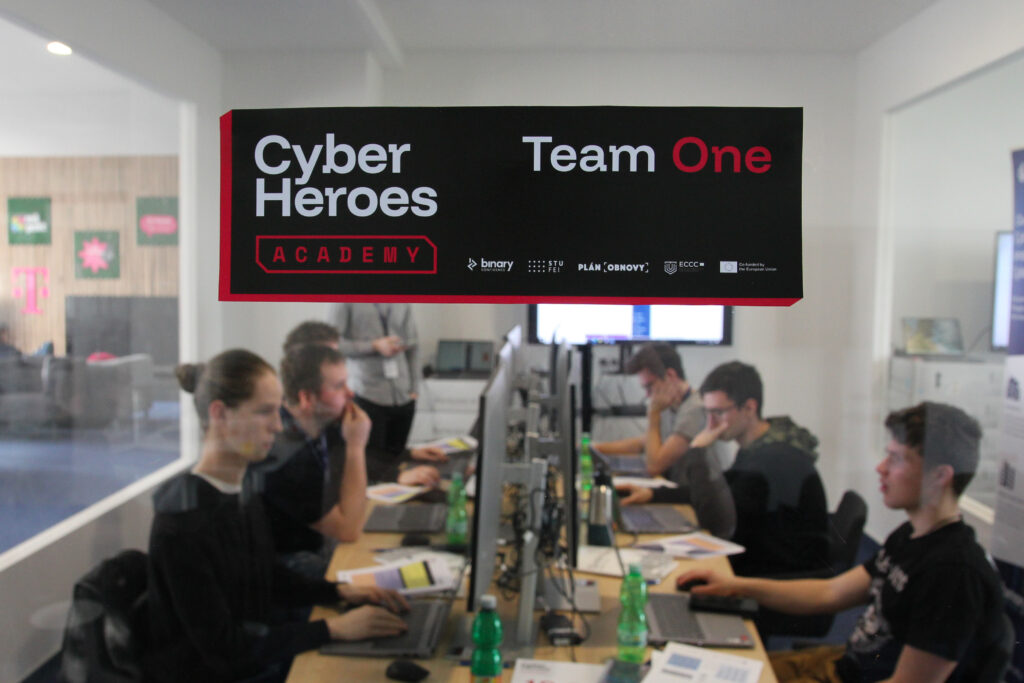
According to Balogh, cybersecurity is attractive to young people precisely because it changes quickly, brings new knowledge, and gives them a chance to understand a world that remains hidden beneath the surface for most people. Interest in cybersecurity is also growing year on year, as shown by the number of applications to the program. What has been missing is the practical component where students can test theory in real-world-like scenarios.
Bridge Between Theory and Practice
FEI RANGE makes it possible to safely simulate both attack and defense. Students work in an isolated environment that behaves like a smaller organization with its own infrastructure, services, users, vulnerabilities, and security tools.
The environment can be used to train account compromise, attacker lateral movement, phishing-based initial access, exploitation of vulnerabilities, malicious code execution, ransomware-based disk encryption, or abuse of system misconfigurations. The Blue Team must detect the attack, understand it, document it, respond to it, and, if possible, restore availability. The Red Team simulates the attacker and learns to think in a way that defenders need to understand.
This is a fundamental difference compared with a standard laboratory exercise. Students need to know where to look for the attack, what individual indicators mean, how events in the network are connected, and what happens when a defender reacts too late or incorrectly. “We want students to avoid reacting randomly during an incident. They should know what to look at, what connections to investigate, and how to proceed when dealing with a specific type of attack,” explains Štefan Balogh.
Technical Specifics of FEI RANGE
From a technical perspective, FEI RANGE is an isolated and segmented cyber range infrastructure built on university hardware. The environment is designed to safely separate training from the university’s production systems while enabling a realistic simulation of a corporate network.
The solution includes:
- virtualized environments
- network segmentation
- firewall control
- separate access zones for the Red Team and Blue Team
- management for the White Team
- simulated internet
- DMZ and other segmented server networks
- internal office networks, with optional WiFi networks for visitors
- monitoring and exercise evaluation
From a teaching perspective, variability is especially important. FEI STU will have access to two independent training environments and two fully equipped classrooms. This will make it possible to run standalone or combined exercises. “One room can host the Blue Team, the other the Red Team, and both groups can work against each other in the same scenario,” says Peter Kleinert, Head of R&D at Binary Confidence.
Another major advantage is preparation speed. Students do not have to spend the entire exercise setting up a lab, installing tools, or dealing with technical obstacles. The environment is prepared so that, after a short introduction, they can move directly into attack, defense, analysis, and decision-making.
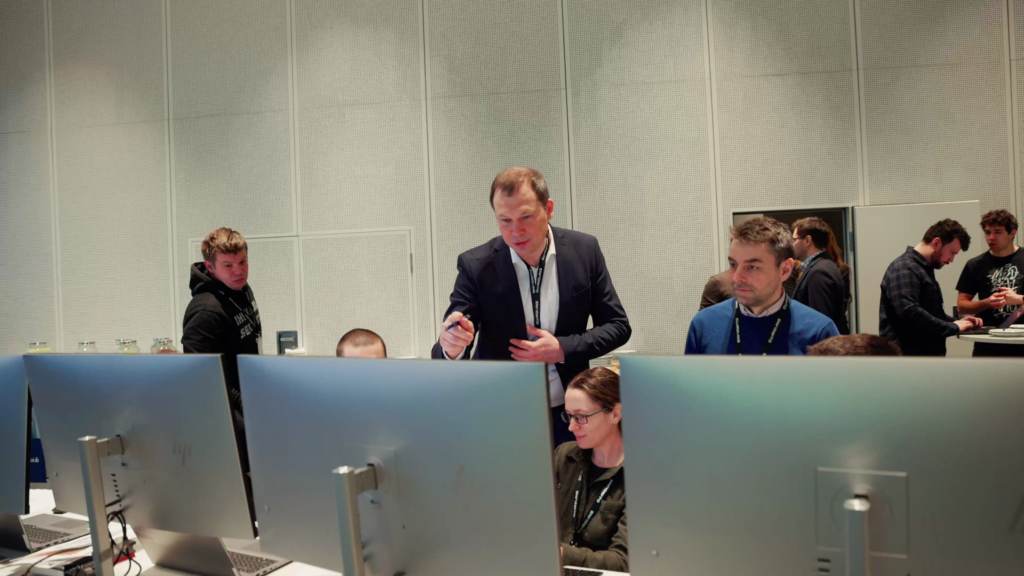
“For a student, there is a huge difference when they can enter a prepared environment after just a few minutes and become productive – attacking, defending, or performing forensic analysis without spending half of the exercise setting up the lab,” adds Peter Kleinert.
Practical Courses Taught by Binary Confidence Experts
The cyber range at FEI STU will be part of practical teaching, with Binary ConfidenceStudents will therefore have the opportunity to learn from people who handle security incidents, SOC monitoring,forensic analysis, and organizational defense in real-world environments.
The goal is for students to acquire not only tools during the semester, but above all a way of thinking. How to look at an incident, divide responsibilities within a team, document findings, distinguish an important signal from noise, and respond in a way that makes defense structured rather than improvised.
Companies often have to teach graduates this type of experience only after they start work. If a student encounters a similar environment already at university, the path between academic knowledge and real-world usability becomes significantly shorter.
The Future of Cybersecurity Begins at Universities
Cybersecurity will become even more important in the coming years, and from the perspective of statistical threat trends, there is no indication suggesting otherwise. Companies will need more analysts, incident responders, and forensic specialists who can connect technology with decision-making.
It is essential to build environments where such people can grow. FEI RANGE connects university education, technology, and practical experience. It gives students the opportunity to experience an incident before the real one arrives, which significantly increases their chances of success during a real incident. For the labor market, the range offers a chance to recruit graduates who do not have to start from zero and can be deployed into standard operations soon after being hired.

This activity is supported by the European Cybersecurity Competence Centre (ECCC) as part of the project under grant code 101128075, and by the Ministry of Investments, Regional Development and Informatization as part of the state programme of the Recovery and Resilience Plan of the Slovak Republic under project grant code 17I04-04-V02-00002.